Note-Taking Methods: Cornell Notes Template, Aesthetic Notes and Sharing Notes
There's no single best way to take notes. There are a handful of proven methods, and the right one depends on the subject and on how you study afterwards. This guide covers the main note-taking methods, a Cornell notes template you can copy, aesthetic notes that are still useful, and how to collaborate on notes with other people.
The main note-taking methods
1. Cornell notes
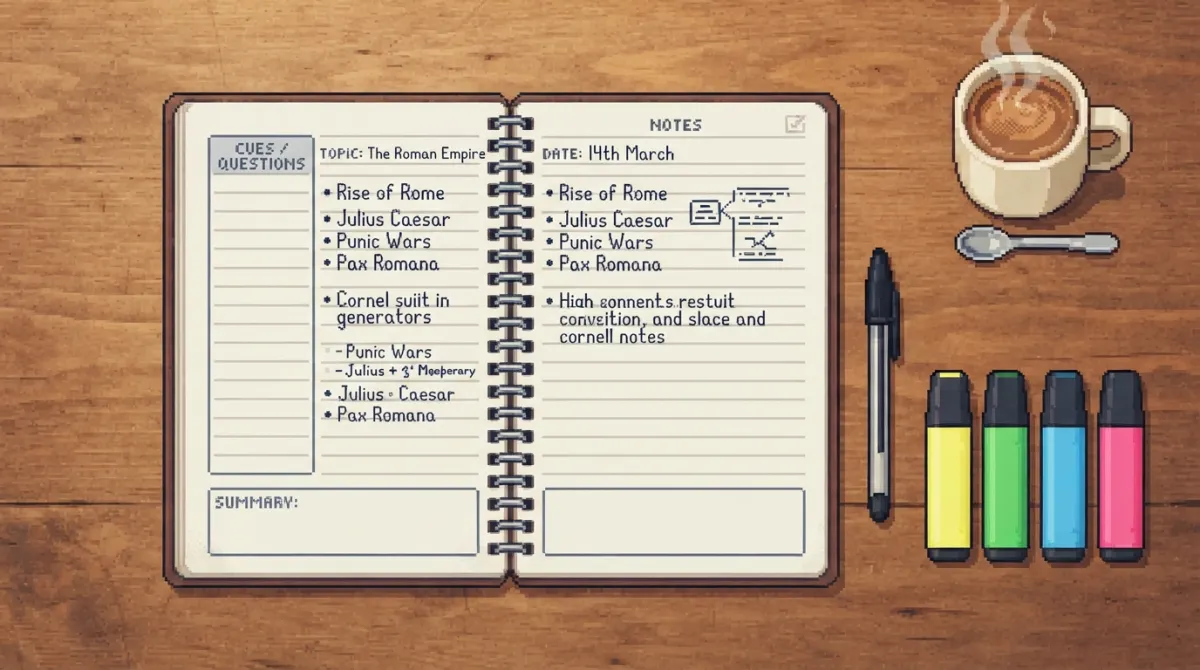
The Cornell system splits a page into three parts: a narrow cue column on the left, a wide notes area on the right, and a summary box at the bottom.
A Cornell notes template you can draw in a minute:
- Draw a vertical line about 6 cm from the left edge of the page.
- Draw a horizontal line about 5 cm from the bottom.
- Put the topic and date at the top.
- Right column: take notes during the lecture or while reading.
- Left column: after class, write keywords or questions that each note answers.
- Bottom box: summarise the whole page in two or three sentences.
To revise, cover the right column and answer the cues on the left. It builds self-testing into your notes. It's the best all-round method for lectures. You can read more on note-taking in general on Wikipedia.
2. Outline method
Headings, sub-headings and bullets, indented by importance. Fast and clear when the lecturer is organised. Weak when ideas jump around.
3. Mapping (mind maps)
Put the main topic in the centre and branch outward. Good for seeing how ideas connect, and for brainstorming essays. Poor for dense detail.
4. Charting
Columns and rows for comparisons: dates, causes and effects, drug classes, theories. Excellent for any subject full of "compare these".
5. The sentence method
Every new point on its own line, numbered. It's fast for quick-moving lectures, and you can tidy up later.
6. Flow notes
Write your own understanding as it forms, with arrows and diagrams, rather than copying what's said. Slower, but it forces thinking.
Which one should you use?
- Lectures with a clear structure: Cornell or outline.
- Reading a textbook: Cornell, or mapping.
- Comparing things: charting.
- Fast, messy lectures: sentence method, then rewrite.
- Problem-heavy subjects like maths: worked examples, with reasoning in the margin.
Handwritten or digital?
Handwriting slows you down, which pushes you to summarise and understand. Typing is faster and easier to search and edit. If you type, resist copying everything word for word. For apps, a free note-taking app on a tablet or laptop, like OneNote or Google Docs, is enough. Our post on study websites that actually help covers tools worth keeping.
Aesthetic notes: pretty is fine, if it's useful
Aesthetic notes with neat headings, colour and doodles can be fun and make you want to open your notebook. Just watch the ratio. If you spend an hour on lettering and ten minutes on content, you're decorating, not studying. A good rule: use two or three colours with a purpose (for example one for definitions, one for examples, one for things to check), and keep decoration for after the content is done.
How to collaborate on notes
Sharing notes can double your coverage and expose your blind spots. A few ways to do it well:
- Split topics. Each person writes notes on one section, then you swap and teach each other.
- Use one shared document (like Google Docs) so edits are live and nothing is lost.
- Compare after the lecture. Five minutes comparing notes catches things you missed.
- Agree on a format so the notes can be merged easily.
- Question each other. Turn each other's notes into quiz questions.
In V.Study Space you can do this in a private room for 2, 4 or 6 friends: sit at the same table with a shared document open, work on the notes, and use the water room or balcony when you want a break and a chat. Our guides to online group study and how to study as a group cover the routine.
Turn notes into a study guide
Notes are raw material. Once you've got a few weeks of them, condense into a study guide that you revise from. We show how in how to create a study guide.
Ask people who've done it
Not sure which method suits your course? Ask. The V.Study Space community has students from many subjects and exams. Post a photo of your notes and ask how others lay theirs out. Someone who's already passed the same exam will usually tell you exactly what they'd do differently. Join free, then sit at a table, start a focus timer and try one new method this week.